
With dLocal, gaming companies can turn that demand into sustainable revenue by offering local payment experiences across 60+ emerging markets and 1,000+ local and alternative payment methods, while we handle FX, compliance, and payout flows behind the scenes.
Use it when you:
-

Want to build direct-to-consumer (D2C) flows
in high-growth regions and reduce dependency on app-store commissions.
-

Need to reduce cart abandonment on checkout and top-up flows
by offering local payment methods and currencies in a white-label experience (no redirects to external PSP pages).
-

Operate free-to-play or hybrid titles and must balance fraud prevention
with frictionless in‑game purchases.
-

Need structured payouts
to creators, studios, esports teams, or other partners across countries
-

Run a multi-party gaming marketplace
(keys, skins, items, channels, or third‑party sellers) and need structured payins plus payouts to multiple sellers.
-

Have regional publishers, distributors, or B2B buyers
who need invoice-based payments in local currency.
The challenge of gaming payments in emerging markets
-
 Your current state
The challenge of gaming payments in emerging markets: High cart abandonment and payment friction
Players drop off at checkout when their preferred local method isn't available, prices show in a foreign currency with unclear conversion rates and surprise foreign-transaction fees, or, worse, they're redirected to an external PSP page that breaks the in-game experience.
Checkout friction cause player drop-off
 Gaming solution
Solutions: Localized payins for gamers
With Payins, you expose local cards, bank transfers, real-time payments, wallets, cash, and (in some markets) mobile money per country, with smart routing and intelligent retries to boost approval rates and reduce cart abandonment.
Localized, no-redirect checkout maximizes payment conversions
-
 Your current state
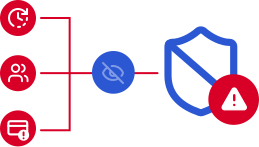
The challenge of gaming payments in emerging markets: Fraud, chargebacks, and abuse
Card testing, account takeovers, promotion abuse, refund abuse, and stolen payment instruments are common in gaming, especially on small‑ticket, high‑frequency transactions.
Frequent microtransaction fraud and abuse drain profits
 Gaming solution
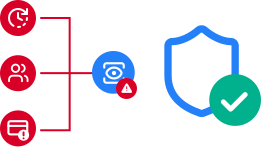
Solutions: Fraud and dispute control tuned to gaming
Defense Suite gives you real‑time monitoring, ML‑driven scoring, device fingerprinting, and chargeback workflows to control fraud and abuse while preserving player experience.
Microtransaction abuse is prevented.
-
 Your current state
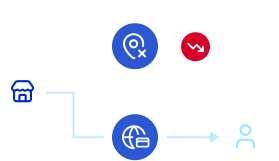
The challenge of gaming payments in emerging markets: Low international card penetration
In many emerging markets, a significant slice of your audience has no international credit card, paying instead with local cards, wallets, or bank schemes, with mobile money also playing a key role across Africa.
Low international card adoption locks out emerging market players
 Gaming solution
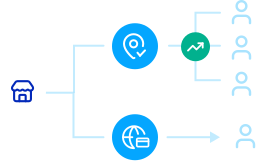
Solutions: Payouts to sellers, creators, and partners
Payouts lets you pay streamers, creators, marketplace sellers, or regional distributors in their local currency via bank, wallet, card, or mobile money, with dLocal managing FX and local rails
Local payment rails, wallets, and mobile money unlock non-cardholder markets
-
 Your current state
The challenge of gaming payments in emerging markets: Heavy reliance on app stores and operational/regulatory complexity
App store commissions can take up to ~30% of revenue, pushing studios toward direct-to-consumer channels; meanwhile, managing FX, settlements, local tax rules, and compliance per country drains resources and slows launch cycles.
High app store commissions and complex FX/tax compliance erode revenue and slow global launches
 Gaming solution
Solutions: Direct-to-consumer monetization with less regulatory burden
Web or launcher-based purchase flows using local payment methods reduce dependency on app stores, while dLocal's local entities and licenses — including Merchant of Record where applicable — handle tax, FX, and KYC/AML obligations market by market.
Direct-to-consumer flows and local entity coverage bypass app store fees and compliance burdens
Key solutions for Gaming
Explore all-
Payins
The core of your gaming revenue
Learn more about PayinsCollect local payments for in-game purchases, top-ups, subscriptions, and DLC via cards, wallets, bank transfers, real-time payments, cash, and mobile money in 60+ emerging markets in a fully white-label experience.
-
Payouts
Pay in their preferred method and currency
Learn more about PayoutsPay creators, partners, esports teams, suppliers, and publishers in local currencies and methods, with dynamic FX and robust reporting.
-
Invoice Collection
For B2B
Learn more about Invoice CollectionCollect B2B payments (publishers, distributors, agencies) using invoice links in local currencies, while dLocal manages FX, settlement, and documentation.
-
Defense Suite
Protect from fraud
Learn more about Defense SuiteProtect revenue with real-time fraud detection, device intelligence, and dispute management tuned to digital and gaming patterns.
-
dLocal for Platforms
Unified payment orchestration for gaming marketplaces.
Learn more about dLocal for PlatformsOrchestrate multi-party flows for gaming marketplaces, with seller onboarding, balances, and split payments handled in one layer (when your model requires it).
-
dMoRe
(Merchant of Record)Turn players into payers everywhere.
Interested in dMoRe?dMoRe handles tax, payments and compliance for your games, plus co-marketing with wallets and other local payment methods to help you acquire new players, all without local entities.
Benefits for Gaming Payments in emerging markets
-

Higher conversion and ARPU
Local payment methods and smart routing maximize approval rates, reducing friction and churn.
-

Simpler operations and reconciliation
One API across 60+ markets centralizes reporting, payins, payouts, and financial reconciliation.
-

Reduced regulatory and FX burden
Local licenses and Merchant of Record coverage handle regional tax, FX, and compliance automatically.
-

Faster expansion into new markets
Reuse a single integration to enter new regions fast and test localized pricing without rebuilding stack.
Key payment flows
-
Player purchases and top-ups
This is the standard consumer flow for games, skins, in‑game currency, battle passes, or DLC:
- 1 Player selects an item or amount.

They choose a pack, skin, pass, or bundle, typically priced in local currency.
- 2 Player picks a local payment method.

At checkout, inside your branded, white-label flow, the player sees familiar options: local and international cards, bank transfers, real-time payments, wallets, cash vouchers, or mobile money, depending on the country and device.
- 3 dLocal processes the payment locally.

The transaction is routed through local acquirers and methods to maximize approvals and minimize soft declines.
- 4 The game entitles content in real time.

Once successful, you receive an authorization response and immediately deliver the item or credit the player's balance.
- 1
-
Subscriptions, passes, and memberships
For season passes, VIP memberships, or recurring subscriptions
- 1 Player selects a recurring plan and agrees to recurring billing in local currency.

- 2 dLocal processes the initial payment

With local acquiring, 3-D Secure where needed, and tokenization where supported.
- 3 On renewal dates, you trigger recurring charges

dLocal optimizes routing and retries to maintain a high success rate and reduce involuntary churn.
- 1
-
Marketplace and multi-seller flows
In gaming marketplaces and resellers:
- 1 Buyers pay via local methods using Payins.

- 2 With dLocal for Platforms

the transaction is split between the platform and one or more sellers (for example, multiple items from different merchants in a single basket).
- 3 Seller balances are updated

Payouts disburses funds in local currency on your chosen schedule.
- 1
-
B2B and partner payments
For distributors, marketplaces, or other B2B buyers:
- 1 You issue invoices via Invoice Collection in local currencies

- 2 Partners pay through local methods

(bank transfers, local cards, etc.), and dLocal handles FX conversion and settlement into your base currency.
- 1
Industry-Relevant Payment methods
For gaming in emerging markets, offering the right mix of local methods is critical to driving first‑time purchase and repeat spend:
See all payment methods-
Cards
Core rails for many players, especially when combined with 3DS and tokenization to keep gamers and platforms protected while supporting quick repeat purchases.
-
eWallets
Popular in Asia, LATAM, and elsewhere; they are often the default digital payment method, especially for mobile‑first gamers.
-
Bank transfers and real-time payments
Methods like Pix and other instant schemes enable fast top‑ups and purchases with lower friction and high reliability.
-
Cash and cash-based networks
Cash vouchers and over‑the‑counter payments help convert cash‑reliant audiences into paying users.
-
Mobile money
In many African markets, mobile money is essential for reaching underbanked gamers and supporting micro‑transactions.
Got questions?
-
How does dLocal help improve conversion for gamers in emerging markets?
dLocal connects you to local methods and local acquiring, reducing declines caused by cross‑border processing and limited international card usage.
By exposing wallets, bank transfers, real‑time payments, cash, and mobile money per country, you align checkout with how gamers actually pay day‑to‑day.
-
Can we use dLocal only for emerging markets while keeping other PSPs for mature regions?
Yes. Many merchants use dLocal specifically for emerging markets, routing traffic to dLocal based on geography and leaving existing PSPs in place elsewhere.
Reporting and settlements from dLocal can be combined with other providers in your existing BI and treasury tools.
-
How does dLocal handle fraud and chargebacks for gaming transactions?
Defense Suite provides real‑time monitoring, ML‑based scoring, and device fingerprinting across your dLocal traffic.
Chargeback and dispute workflows help you respond efficiently and feed outcomes back into models and rules to improve future performance—all while minimizing friction for legitimate players.
-
Do we need local entities in every country to accept payments and pay partners?
No. A core advantage of dLocal is that you can operate in 60+ emerging markets without setting up local entities in each of them.
dLocal leverages its own entities, licenses, and Merchant‑of‑Record role (where applicable) to handle local regulatory, tax, and FX obligations.
-
Can dLocal support gaming marketplaces and multi-seller models?
Yes. dLocal for Platforms is designed for marketplaces and platforms that need to handle multi‑party flows, including split payments, mixed baskets, and seller balances.
You can onboard sellers, manage their payout preferences, and settle in local currencies, while dLocal handles local rails and compliance.
-
How fast can we go live with dLocal for Gaming?
Timelines depend on scope, but the single API, hosted options, and dashboard‑driven configuration are built for fast onboarding.
You can start with priority markets and methods, then expand coverage and add advanced flows (marketplaces, B2B invoices, more payout corridors) as you scale.
Ready to grow your Games in emerging markets?
If you’re ready to level up your gaming revenue in Africa & Middle East, Asia, and Latin America, talk to dLocal about how our solutions can support your expansion, and help you turn more players into paying, long-term users.
Grow your business