What are settlement models and how they can unlock strategic value

In this new installment of the Paymentpedia series, we analyze the different settlement models, their advantages, and what is most suitable for each type of business.
When companies expand across emerging markets, they often focus on checkout optimization: localizing UX, adding local payment methods, and improving approval rates.
But an equally important, bottom-line-defining operational reality occurs long after a customer clicks the payment confirmation button. This process, the settlement, determines how funds change hands through the underlying financial infrastructure.
For many multi-market corporate finance teams, the mechanism by which cash goes from a card reader screen to the corporate treasury remains a backend configuration.
The reality, however, is that how money travels, where it lands, and when foreign exchange (FX) conversion occurs represent core corporate treasury positions rather than minor payment parameters. It also determines control over cash flow and margin exposure.
Many merchants inherit a settlement setup from their payment provider without treating it as a strategic choice. That can be costly. In volatile markets, settlement architecture affects FX risk, liquidity, operational complexity, and regulatory exposure.
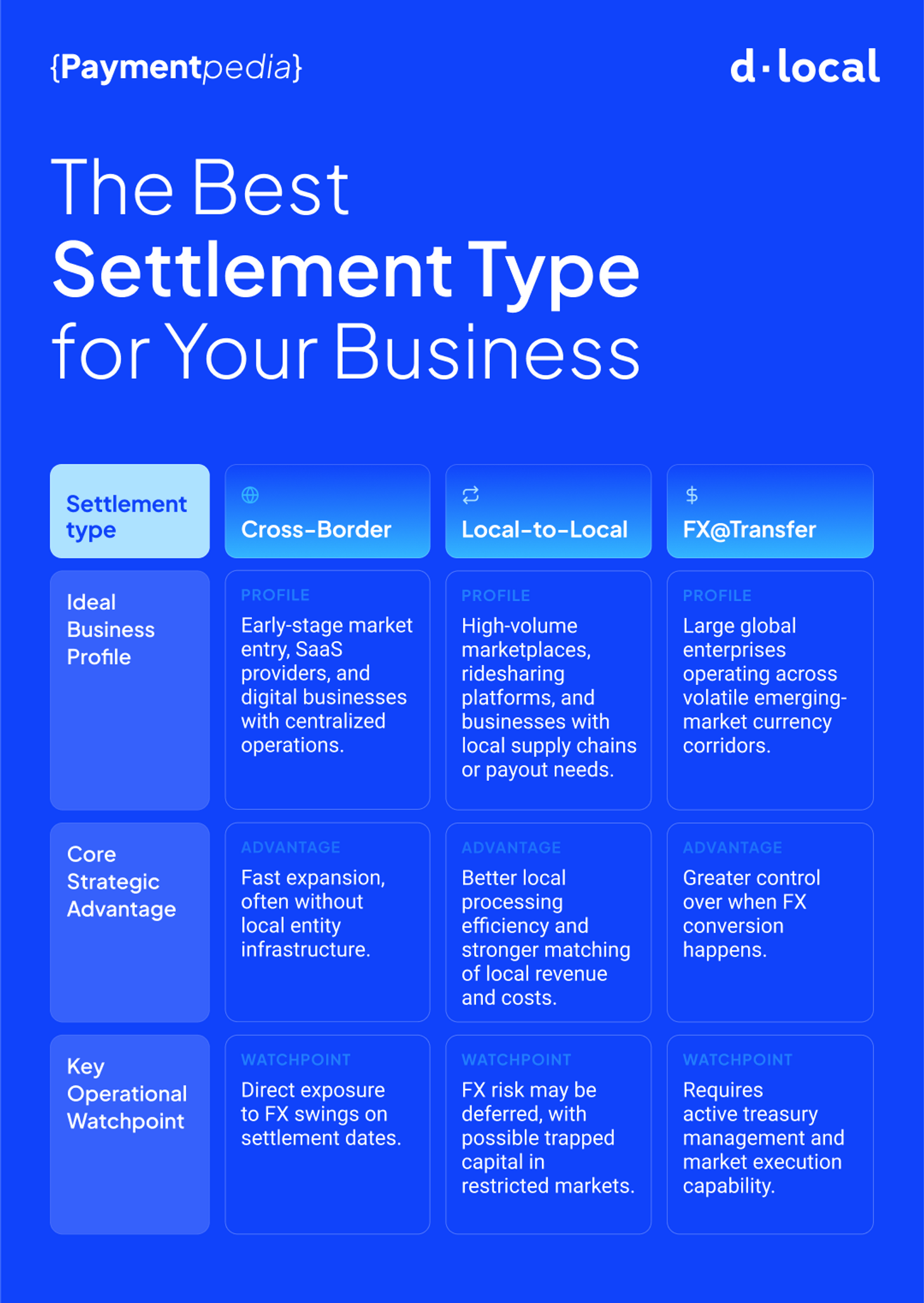
The three main models are Cross-Border, Local-to-Local, and FX@Transfer.
Cross-Border
Cross-border settlement is often the fastest way to enter a new market. Customers pay locally, the processor collects funds domestically, typically converts them into a hard currency such as USD or EUR at collection or settlement depending on the provider and market setup, and settles the balance into the merchant's offshore account. This often allows companies to launch without establishing a local entity or domestic bank account.
Its main advantage is speed and simplicity. Companies can test demand and scale internationally without setting up local legal and banking infrastructure. It also centralizes collections into one treasury destination.
The trade-off is FX exposure. Because conversion happens according to the provider's settlement timing, merchants may be exposed to adverse exchange-rate movements between transaction and settlement. Finance teams should understand which FX rate is applied, when it is locked, and how much control they have over conversion timing.
From a regulatory perspective, this model can provide a compliant path for foreign businesses to collect local funds through licensed intermediaries, subject to local FX, tax, remittance, and reporting rules.
Local-to-Local
As volumes grow, many enterprises move to a local-to-local model. In this setup, customer funds are collected and settled in local currency, typically into the merchant's domestic bank account through its in-country entity. No FX conversion happens during the initial domestic settlement cycle.
This model improves processing efficiency. Transactions stay on domestic rails, which can improve approval rates, reduce cross-border costs, and support local payout needs. It is especially useful for marketplaces, ridesharing, delivery platforms, and other businesses with significant local expenses or supplier payouts.
The main risk is trapped capital. If revenue exceeds local operating needs, cash can build up inside the country and become harder to repatriate, especially in markets with liquidity constraints or capital controls. In practice, this model often defers FX risk rather than removing it.
Regulators often view local-to-local structures favorably because they anchor activity within the domestic economy and fit more naturally into local tax, oversight, and compliance frameworks.
FX@Transfer
FX@Transfer is a more flexible model for companies operating at scale in volatile currency markets. Funds are collected locally, but conversion does not happen immediately. Instead, balances are held until the treasury team decides when to convert and transfer them internationally.
Its main advantage is control. Treasury teams can avoid forced next-day conversion, choose better timing, smooth FX volatility, and align conversion with internal hedging or liquidity policies. That can help protect margins in unstable markets.
The trade-off is complexity. This model requires treasury expertise, visibility, and active decision-making. If the team lacks the tools or capability to manage currency positions, the flexibility may not create real value. It also leaves unconverted balances exposed to local market risk for longer.
For regulators, this model can support more orderly and predictable capital outflows when managed through compliant local operators.
Flexibility and Stability
Ultimately, there is no single best settlement model — only the one that best fits a company's stage, operating footprint, treasury needs, and risk appetite.
Cross-border, local-to-local, and FX@Transfer each solve for different priorities, and the most effective strategy is often to use them deliberately across markets rather than defaulting to one approach everywhere.
Additionally, stablecoins are also starting to emerge as an important development in this space. They combine the speed and flexibility of crypto infrastructure with the stability of fiat, which could make them an increasingly relevant complement to traditional settlement models over time.
In the right regulatory and compliance framework, they can help simplify cross-border collections and payouts, accelerate treasury operations, consolidate liquidity across markets, and enable near-instant settlement flows.
The space is still in its early stages, and many of the regulatory and operational frameworks around it are still evolving.
But for many industry participants, the long-term potential is clear: if adoption and regulation continue to mature, stablecoins could become an increasingly important part of how international settlements are designed in the years ahead.