Shoppers across seven high-growth markets told us how they pay, switch brands, and decide who earns their business.
Full survey results.
Mexico
Argentina
Brazil
Thailand
Philippines
Kenya
Nigeria
Today the Global South is the world's greatest path for growth opportunities, yet for far too many they remain unexplored.
The blind spot
Most of the consumer research the payments and eCommerce industries rely on is written about a small number of mature, high-income markets.
Detailed, comparable data on how shoppers actually behave in Latin America, Africa and Southeast Asia is relatively scarce, despite the fact that this is where the next several billion consumers are coming online. Brands, retailers and payment providers are making expansion decisions with far less evidence than they would demand before entering the U.S. or Western Europe.
01
65% of global growth by 2035
Southeast Asia's GDP reached $4.25 trillion in 2025, growing at double the global rate. Sub-Saharan Africa alone is projected to be home to roughly 1 in 5 people on Earth by the second half of this century.
02
A demographic tailwind
By 2027, nearly 90% of millennial and Gen Z consumers are expected to live in these regions. Six of the seven markets surveyed have significantly younger populations than the U.S. or Western Europe. Thailand is the exception, with growth driven instead by rapid mobile-payment and eCommerce adoption.
03
Three converging growth stories
Latin America's deepening payment infrastructure, led by Brazil's mobile-first eCommerce boom; Africa's mobile-money-driven leap past traditional banking; and Southeast Asia's app-first shoppers — brands that adapt to each region's realities will be best placed to win the next wave of consumers.
This report is intended as a practical guide for companies operating in these markets, and for those evaluating to enter them.
It combines original survey data with dLocal's prior LATAM research and publicly available market data to answer three questions: what stops consumers from buying cross-border today, how they actually feel about U.S., European and Chinese brands, and what it would take to convert more of them into loyal customers.
The survey was designed to capture consumer perspectives on online shopping and payment experiences across emerging markets.
Survey methodology
Fielded between 10–30 July 2026, the questionnaire included single-select, multi-select, matrix and open-ended questions covering payment barriers, local payment preferences, cross-border purchasing and online shopping habits. All 1,358 included records were marked complete and recorded 100% progress in the final dataset. Respondents passed an attention check.
The findings should therefore be read as reported consumer responses from the surveyed markets, rather than as macroeconomic estimates or a substitute for broader market research. The survey’s consumer-level approach is distinct from the separate handbook research, which uses a more macro, country- and region-level perspective.
Payment friction is nearly universal and it costs sales
Across all seven markets, preferred payment options are not a nice-to-have. Nearly 99% of respondents said accessible payment options are important when shopping online, including 57% who called them "extremely important." Only about 1% said payment accessibility doesn't matter to them at all.
Importance of accessible payment options when shopping online
99%very or extremely important
1%not important
57% of all respondents called accessible payment options "extremely important." Source: original online survey fielded on behalf of dLocal, July 2026. n=1,358. Countries: Mexico, Argentina, Brazil, Thailand, the Philippines, Kenya, Nigeria.
Barriers consumers face when paying for products online
When asked what barriers they face when paying for products online, affordability topped the list, closely followed by the unavailability of Buy Now, Pay Later (BNPL). Interestingly, the absence of alternative payment methods such as e-wallets, bank transfers, mobile payments or prepaid cards came in nearly as high, while a smaller share pointed specifically to products not being priced in their local currency.
Some respondents also volunteered concerns about shipping cost and speed, product-photo mismatches, and trust in sellers — practical, fixable friction points rather than fundamental resistance to cross-border shopping.
What's stopping them from paying
43%Affordability
37%BNPL not offered
37%No alternative payment methods
20%Products not priced in local currency
Multi-select; totals do not sum to 100%. Source: original online survey fielded on behalf of dLocal, July 2026. n=1,358. Countries: Mexico, Argentina, Brazil, Thailand, the Philippines, Kenya, Nigeria.
Payment localization is the single lever with the most leverage over purchasing behaviour
93% of respondents said being able to use their preferred local payment method (such as Pix, a bank transfer, or a mobile wallet) on an international site would make them more likely to buy from a foreign brand, including 55% who said "much more likely." That figure reaches 97% in Nigeria and 96% in Brazil, both markets where mobile money and Pix, respectively, are already the default way people pay.
97%
96%
93%of consumers
are more likely to buy from a foreign brand when their preferred local payment method is accepted
Combines "somewhat more likely" and "much more likely"; 55% said much more likely. Source: original online survey fielded on behalf of dLocal, July 2026. n=1,358.
Asked which recent payment development has had the biggest impact on their shopping over the past year, most respondents pointed to some form of payment localization. Loyalty will be gained by whichever brand removes friction first.
51%
of respondents say payment localization had the biggest impact on their shopping this year — split two ways:
28%More sites accepting local payment methods
24%More sites accepting local currency
When asked what would make them more likely to purchase from U.S. eCommerce brands, only 2% selected "nothing would change my likelihood." In other words, 98% of respondents have at least one concrete, addressable reason they aren't already buying more from foreign brands. This is a solvable problem, not an entrenched preference for local retailers.
This mirrors a shift already visible in how the region's biggest platforms compete. Amazon has disclosed spending more than $100 billion over roughly fifteen years building out its fulfillment and last-mile delivery network. Mercado Libre planned $13.2 billion in regional infrastructure investment in 2025 alone, with 95% of what it sells moving through its own logistics network. That decade-long arms race in delivery spend is a large part of why fast, reliable shipping is already the single biggest purchase driver in this survey. Nevertheless, the same intensity of investment hasn't yet been matched in payments, which is exactly where the next behaviour change is coming from.
Credit Innovation vs. Basic Access
Asked how likely they'd be to buy from a site that didn't accept their local currency or an alternative payment method, 71% said they'd be unlikely to (30% "very unlikely," 42% "somewhat unlikely"), versus just 15% who'd purchase anyway.
Resistance was highest in Argentina, where 82% said they'd be unlikely to buy without local payment support, showcasing the strongest reaction of any market surveyed. The most flexibility was found in Brazil and Thailand, where roughly 1 in 5 shoppers said they'd still buy regardless of payment methods offered.
Likelihood of buying from a site that does not accept local currency or an alternative payment method
71%Unlikely to buy 30% very 42% somewhat
15%Would still purchase
Source: original online survey fielded on behalf of dLocal, July 2026. n=1,358. Countries: Mexico, Argentina, Brazil, Thailand, the Philippines, Kenya, Nigeria.
Credit Innovation vs. Basic Access: Why One Payments Roadmap Won't Fit All Markets
Payment localization is the dominant story across these markets, but the specific mechanism changing behaviour isn't the same everywhere. In Latin America and Africa, the developments respondents cite as most impactful are still foundational: more sites accepting local currency or local payment methods. These markets are still closing the basic access gap.
Southeast Asia tells a different story. In the Philippines, BNPL is the single most-cited driver by far, at 35%, roughly double the seven-market average of 18%. In Thailand, BNPL (30%) and wallet integrations such as cross-border Pix linking (30%) together account for 60% of responses, dwarfing local-currency and local-payment-method acceptance (10% each), which dominate everywhere else. A single global payments roadmap will underserve at least one region.
Payment development with the biggest impact on shopping in the past year
Advanced instruments — what dominates in Southeast Asia
60% of Thailand's responses combined
Market-specific figure
7-market average
Thailand
BNPL expansionPhilippines
35%
BNPL expansionThailand
30%
Wallet integrationsThailand
30%
BNPL expansion7-market avg.
18%
Basic access — what dominates everywhere else
20% of Thailand's responses combined
Local currency acceptanceThailand
10%
Local payment methodsThailand
10%
Bars scaled to a 60% axis. Source: original online survey fielded on behalf of dLocal, July 2026. n=1,358. Countries: Mexico, Argentina, Brazil, Thailand, the Philippines, Kenya, Nigeria.
Brand perceptions: China, the U.S., and Europe
Chinese eCommerce brands enjoy a clear net-positive reputation across these markets, though a less dominant one than in dLocal's 2025 LATAM-only research. 55% view Chinese brands favorably or extremely favorably, versus just 5% negative. Favorability is strongest in Brazil (25% "extremely favorable"), Kenya (22%) and Nigeria (20%), and softest in Thailand and the Philippines, where neutral responses dominate and negative sentiment is highest (9% and 8%).
On broad favorability, U.S. and European brands beat China everywhere. But on the strongest form of endorsement, "extremely favorable," China leads the U.S. in Nigeria (20% vs. 18%), Brazil (25% vs. 24%) and Kenya (22% vs. 19%), and leads Europe in those same three markets plus Argentina.
Favorable opinions don't automatically convert into frequent purchases
Despite roughly comparable favorability for U.S. and European brands, 44% of respondents say they buy from Chinese brands often or all the time, compared with 32% for U.S. brands and just 21% for European brands; a gap almost certainly tied to more aggressive localization of pricing, payments and logistics. However, when asked how often they purchase from Chinese eCommerce sites specifically, the answer was more conservative at 29%, suggesting a difference between Chinese goods and Chinese retailers for consumers.
Table — Brand favorability and purchase frequency, by region of origin
Brands from
Favorable
Negative
Buy often
China
55%
5%
44%
United States
66%
2%
32%
Europe
58%
1%
21%
"Favorable" combines "favorable" and "extremely favorable". Source: original online survey fielded on behalf of dLocal, July 2026. n=1,358. Countries: Mexico, Argentina, Brazil, Thailand, the Philippines, Kenya, Nigeria.
What it would take to win these shoppers over
The attributes that would make consumers more likely to buy from U.S. and European eCommerce brands are nearly identical, which suggests companies don't need a region-by-region playbook so much as a universal one.
Shipping remains the single biggest lever, with cost and speed combined cited by roughly 6 in 10 respondents for both U.S. and European brands. However payment localization sits close behind at roughly half, and it's the second-largest gap between what brands typically invest in and what shoppers say actually moves them. While fast, affordable shipping is an expectation, payments can no longer be treated as an afterthought.
Local customer support ranks last for both regions (31% for U.S. and 30% for European brands), well behind every operational factor. By contrast, checkout localization and reliable delivery rank higher, suggesting that consumers place greater priority on being able to pay in their preferred currency and through their preferred payment method, as well as receiving their orders on time.
Factors that would increase likelihood of purchase from U.S. and European eCommerce brands
U.S.
Europe
Lower shipping costs
63%
62%
Faster shipping
57%
56%
Preferred local payment method accepted
51%
49%
Prices in local currency
48%
46%
Local customer support
31%
30%
Multi-select; totals do not sum to 100%. Source: original online survey fielded on behalf of dLocal, July 2026. n=1,358. Countries: Mexico, Argentina, Brazil, Thailand, the Philippines, Kenya, Nigeria.
These markets are already a growth lever, not an afterthought
Unlike mature markets, these markets of the future are a growth lever for retailers. Amazon and Walmart both posted their weakest sales growth in years in early 2025, barely outpacing inflation — yet Walmart's Mexico and Central America division kept growing well ahead of that pace, and its China business faster still.
3.2%
Walmart's weakest sales growth
In years, early 2025
8.3%
Growth in Walmart's Mexico & Central America division
Same period
Amazon posted 3.7% growth in the same period; Walmart's China business grew 18%. Source: company earnings reports, early 2025.
Where the playbook diverges further
Latin America doesn't move as one market. Argentina and Mexico are the two most rigid markets in the study, where only 6% and 5% respectively would buy without local payment support, the lowest figures recorded. Brazil, by contrast, is among the most forgiving, likely reflecting how thoroughly Pix has already normalized frictionless local payment there. A single Latin American strategy risks under-serving Argentina and Mexico while over-investing in a market that has largely already solved this problem for itself.
Southeast Asia has moved past the basic-access question and onto credit and payment innovation specifically. The Philippines shows a related but distinct wrinkle: 64% cite affordability as a barrier to buying online, far higher than any other market (next-highest is Argentina at 46%), and it's the only market where accepting a preferred local payment method beats shipping entirely as the top driver for European brands (64%). For Filipino shoppers specifically, the binding constraint is less about logistics and more about whether they can pay at all.
In Africa, the constraint is speed and credit, not cost. Nigeria and Kenya are the only two markets where faster delivery beats cheaper shipping as the top purchase driver, whereas everywhere else cost wins. The same pattern holds for payments: Kenya's single biggest cited barrier is the unavailability of Buy Now, Pay Later (BNPL), at 59%, nearly 14 points above any other market. Yet when Kenyans are asked what recent payment development has actually changed their shopping, BNPL expansion barely registers (10%), while broader local-payment-method access dominates (42%). This points to unusually strong demand that supply hasn't caught up to yet.
Shifting habits, in shoppers' own words
Two open-ended questions asked respondents to describe, in their own words, what has changed most about their online shopping habits and whether they'd still buy from a foreign brand that didn't accept their preferred payment method despite a significantly lower price. Because these were free-text responses in four languages, the figures reflect a careful thematic reading rather than a fixed-choice tally.
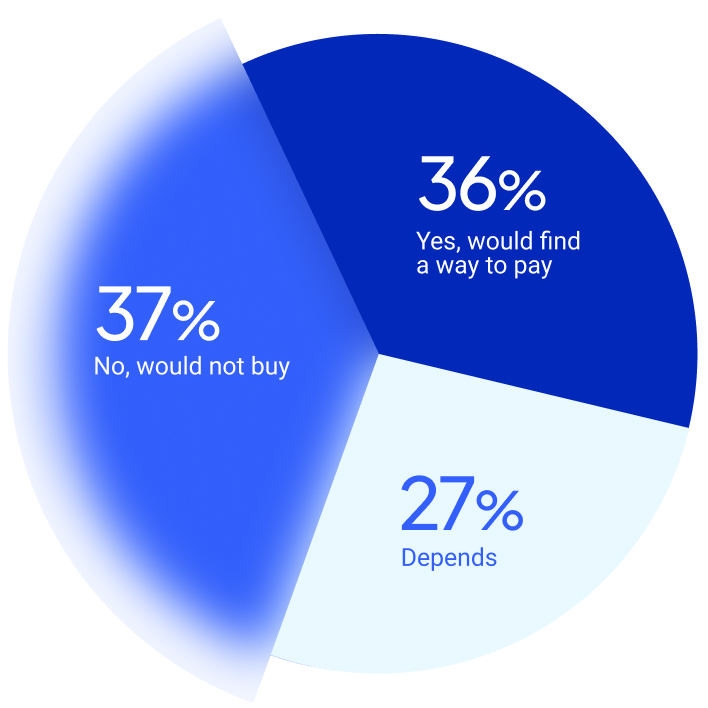
On the price-versus-payment-friction tradeoff specifically, sentiment splits close to evenly three ways. The data reveals there is no single dominant consumer mindset on this tradeoff, which means brands can meaningfully move the needle in either direction depending on how much friction they remove. Respondents in Nigeria (55%) and Kenya (50%) were the most willing to push through payment friction for a lower price, often citing specific workarounds like moving money through mobile wallets or crypto, while the Philippines (49% said no, only 22% said yes) showed the strongest resistance, frequently tied to distrust of foreign-currency conversion and unfavorable exchange rates.
What has changed most about online shopping habits in the past year
More price-conscious, comparing pricesMore price-conscious, comparing prices21%
More careful, research-driven shoppingMore careful, research-driven shopping16%
Shopping online more oftenShopping online more often14%
Shipping cost or speedShipping cost or speed11%
New local payment or currency optionsNew local payment or currency options10%
Nothing has changedNothing has changed9%
Open-ended responses in four languages; approximate thematic codings, directional rather than precise. Bars scaled to a 25% axis. Source: original online survey fielded on behalf of dLocal, July 2026. n=1,358.
Would you buy at a significantly lower price if your preferred payment method were not accepted?
No, would not buy — 37%
Resistance is strongest in the Philippines (49% said no), often tied to distrust of foreign-currency conversion and unfavorable exchange rates.
Yes, would find a way to pay — 36%
Willingness peaks in Nigeria (55%) and Kenya (50%), often citing workarounds like mobile wallets or crypto.
Depends / conditional — 27%
Bars scaled to a 50% axis. Source: original online survey fielded on behalf of dLocal, July 2026. n=1,358.
How these findings compare to past research
dLocal's prior research, The dLocal LATAM Retail & Payments Report 2025, surveyed 1,050 respondents across five Latin American markets (Argentina, Mexico, Brazil, Chile and Colombia, together representing roughly 80% of the region's GDP) in early 2025. Comparing the two studies, while keeping in mind they are separate surveys with different country mixes and sample sizes, shows both striking consistency and a few meaningful divergences.
Chart — 2025 vs. 2026
2025
2026
Change
Say accessible payment options are important
97%
99%
+2
Wouldn't shop without local payment support
69%
71%
+2
Cite affordability as a barrier
29%
43%
+14
Cite unavailable BNPL as a barrier
33%
37%
+4
Cite absence of alternative payment methods
45%
37%
−8
View Chinese eCommerce brands favorably
73%
55%
−18
Consistent with prior LATAM research.
The core finding holds across both studies: accessible, localized payment options are a baseline requirement for online purchase, not a differentiator. That the numbers hold up so closely across a much broader and more diverse set of markets is itself a strong signal that this is a structural feature of shopping in high-growth economies, not a quirk of any one region. Purchase frequency from Chinese eCommerce sites is similarly stable: the previous report found 52% of LATAM respondents shopped "sometimes" and 7% "all the time"; in this year's report it's 55% and 5%.
Where the new markets diverge: affordability is a bigger barrier in this expanded sample than in the LATAM-only study. The unavailability of BNPL is also somewhat more of a sticking point, while the absence of alternative payment methods is a slightly smaller issue than before. Read together, this suggests that as more markets adopt alternative payment methods, the constraint shifts from "can I pay at all" toward "can I afford it"; a maturing, but still very real, friction point. Sentiment toward Chinese brands is also meaningfully nuanced, driven largely by Thailand and the Philippines, likely reflecting a more competitive, more mature eCommerce landscape in Southeast Asia, where regional and hyperlocal platforms already compete hard for the same shoppers.
Download the full survey dataset for deeper analysis
You can download all the report data and the detailed methodology from this link.
Actualizaciones del aviso de privacidad - Colombia
Le informamos que una versión actualizada del aviso de privacidad entrará en vigor el primero de julio de 2025. Hemos realizado cambios en las siguientes secciones: 4. Cuándo podemos revelar los datos personales; 8. Cookies; 9. Sus derechos; 10. Procedimientos para que los titulares puedan ejercer sus derechos en Colombia; 13. Cambios.


 Mexico
 Argentina
 Brazil
 Thailand
 Philippines
 Kenya
Kenya
 Nigeria