
BrazilFrom here to the world
Few countries have changed the way people pay as fast as Brazil. Today, consumers expect to transfer money instantly and pay everyone from major retailers to street vendors in seconds. Behind that shift is Pix, the free, instant payment system built and regulated by the Central Bank of Brazil (BACEN). But the bigger story is how Brazilians have embraced a faster, more inclusive way of moving money.
The way locals pay

Local payment methods to know


 Card
Online payments mix eCommerce 2026 projections
Pix has put Brazil on a new path
Pix has brought millions of under and unbanked citizens into eCommerce for the first time, and has become the primary way Brazilians pay online and in-store. Consumers love this instant, 24/7 and completely free service, and trust it, since the central bank is both its developer and regulator.
The transformation has been fast: by the end of 2025, Brazilians had made nearly 80 billion Pix transactions, and by July 2026 more than 175 million people1 were actively using the system. What began as a way to send money between friends has evolved into an everyday payment habit.
Still, Pix hasn't pushed other payment methods completely out of the picture. Brazilians still shift their behavior depending on the context. Credit cards remain the easiest way to spread large costs over several months. Interest-free installments have been popular in Brazil for decades and now account for roughly 65% of transactions across our top retail merchants in the country. This installment habit keeps Brazil's homegrown card network, Elo, competitive, helping it hold roughly 5% of the market. Cards also keep subscriptions and monthly recurring payments running.
eWallets are also on the rise, led by Mercado Pago, as well as PicPay and NuPay. Boleto Bancário, still favored by those who prefer to pay with cash, fills in the remaining gaps.
Merchants operating here need to balance their support of Pix, credit cards and eWallet payments. By adjusting their checkout so that it always caters to local payment preferences, they're better able to access LATAM's largest digital economy.
Pix is doing more than ever
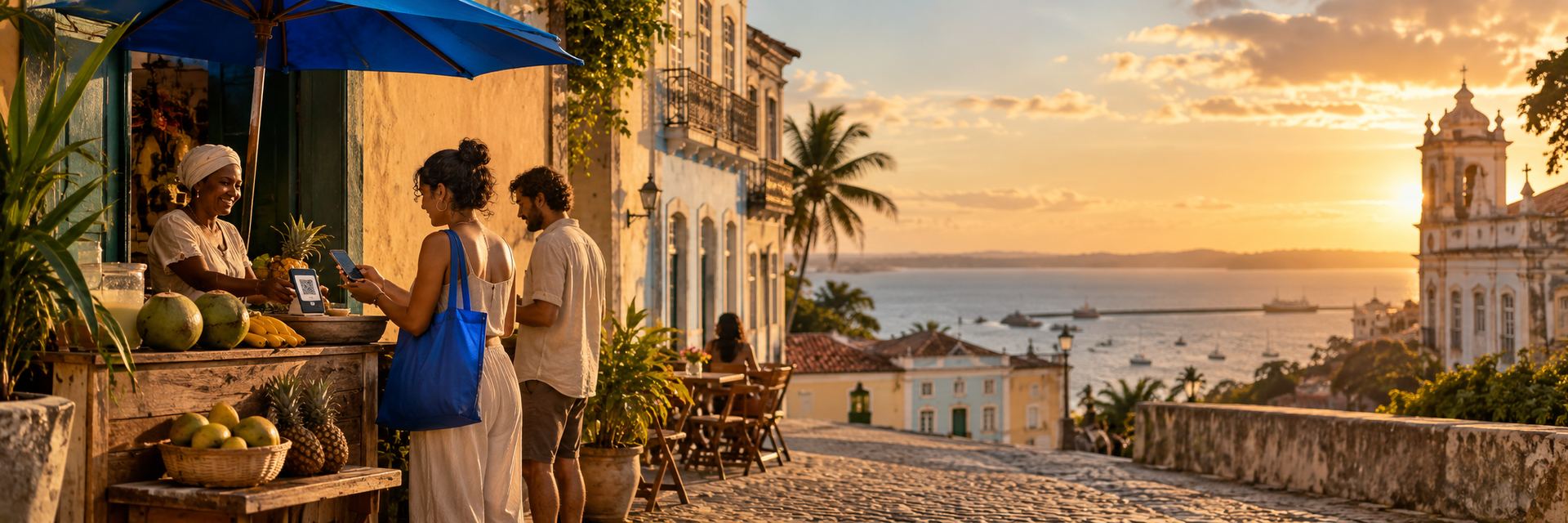
Brazilians increasingly use Pix to pay businesses, not just each other: P2B payments grew 31% between July 2025 and July 2026, overtaking P2P as the largest transaction category. Even street vendors without card machines can now take a payment with just a QR code.
As comfort with instant payments grows, so has demand for more complex payment experiences, reflected in new capabilities introduced over the past two years.
| Feature | Before | Now |
|---|---|---|
| Pix Automático | Subscriptions weren’t possible through Pix | One-time consent authorizes recurring debits, settled instantly via SPI |
| Pix with Biometrics | Merchant payments required redirection to a banking app | Face or fingerprint authentication fires the transfer straight from checkout |
| Pix + BNPL | Installments generally required a card | BNPL providers like Pagaleve let consumers pay in installments using Pix |
Having transformed domestic payments, Brazil is now exploring extending the same experience across borders. BACEN is looking into international links, including Project Nexus, the multi-country platform that could eventually connect it with schemes like India's UPI and Thailand's PromptPay.
If you’d told me five years ago that a market this size could change payment behavior so quickly, I wouldn't have believed you. Pix gave people who’d never fully trusted a bank a reason to join the financial system, and gave everyone else a faster way to pay for everything from groceries to rent. This shift has fundamentally changed how Brazilians engage with the digital economy. And now markets everywhere are asking themselves what would happen if they developed a payment system that was built around local habits and behaviors, one that was truly fit for purpose.
A four-point lead over credit and debit cards
In 2025, Pix and credit cards sat within a point of each other. But during 2026, Pix will move roughly US$ 186 billion in eCommerce, 44% of every dollar spent online in Brazil, creating a four-point lead over credit and debit cards. This gap is projected to keep widening in the years to come.
- Pix
- Cards (credit + debit)
Pix pulls ahead of cards, reaching half of Brazilian eCommerce payments by 2028.


Proof in the numbers: Pix at work
One of our merchants saw Pix reshape its payment mix within months of adding it to checkout. In its first month accepting Pix, the payment method made up just 9% of TPV. By month five, that share had climbed to 47%, nearly matching cards.
Monthly TPV grew 55% between month one and month five, and 90% of Pix users were new customers, showing Pix wasn’t cannibalizing card volume but expanding the customer base entirely.
- Card
- Pix
Five months after adding Pix, almost half of TPV was coming through it. Its share grew from just 9% in month one to 47% in month five.