With dLocal, financial institutions can compliantly process payments in over 60 complex countries, leveraging local e‑money licensing, FX expertise, and direct connections to multiple acquirers per market—without building and maintaining country‑by‑country infrastructure.
Use it when you:
-

Need to collect receivables or deposits
from customers in 60+ emerging markets in their local currencies via local rails.
-

Want to simplify cross‑border settlements and payouts
at scale, reducing reliance on traditional correspondent banking or manual operations.
-

Are building or operating remittance, FX, digital wallet, or financial infrastructure products
and must navigate local payment methods, FX rules, and compliance.
-

Need to centralize reporting and reconciliation
across multiple sub‑accounts, corridors, and partners.
The challenge of financial services in emerging markets
-
 Your current status
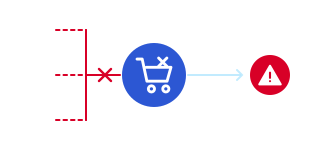
The challenge of financial services in emerging markets: Fragmented alternative payment methods
APMs such as cash networks, eWallets, mobile money, bank transfers, real‑time schemes, and local cards are often more important than traditional international rails—and keep evolving.
Unfamiliar payment methods hinder growth.
 Financial services solution
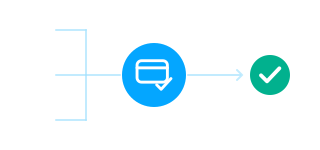
Solutions: Accept local payments via Payins
With Payins, accept local currency payments and bypass some challenges related to currency fluctuations and cross‑border card limitations; funds can later be settled in your chosen currency.
Higher approval rates, fewer minor rejections
-
 Your current status
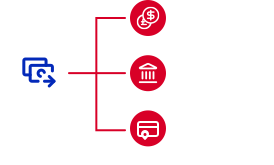
The challenge of financial services in emerging markets: Cross‑border settlements at scale
Managing settlement cycles, fees, and liquidity across dozens of corridors is difficult when relying on multiple local partners and correspondent banks.
Difficulty making multiple payments
 Financial services solution
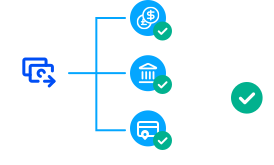
Solutions: Simplify global settlements with Payouts
Payouts helps you run cross‑border payouts at scale, funding one or more central accounts while dLocal orchestrates local disbursements in each market.
Stable renewals, reach beyond cards
-
 Your current status
The challenge of financial services in emerging markets: Fraud and risk in fast‑moving environments
Fraud patterns, social engineering, and mule activity adapt quickly; pure rules‑based systems often lag behind.
Unprotected against fraud
 Financial services solution
Solutions: Adaptive fraud protection with Defense Suite
Defense Suite uses machine‑learning algorithms to quickly adapt to changing fraudulent patterns, helping you protect your flows while preserving a smooth end‑user experience.
Frictionless fraud protection
Key solutions for financial services
Explore solutions-
Invoice Collection
For B2B or enterprise subscriptions
Learn more about Invoice CollectionCollect receivables in over 60 emerging markets from one single integration, using local currency payments and simplifying regulatory and FX challenges.
-
Payins
The core of your income
Learn more about PayinsAccept local currency payments and fund flows in emerging markets, overcoming currency fluctuation and cross‑border limitations.
-
Payouts
Pay using your preferred method and currency.
Learn more about PayoutsSimplify global settlements with cross‑border payouts at scale, paying users, partners, and accounts in local currencies via local rails.
-
Defense Suite
Monitoring, chargeback management, and dispute resolution
Learn more about Defense SuiteUtilize machine‑learning‑driven fraud management to adapt quickly to new patterns and reduce losses while staying compliant and protecting customer trust.
Benefits for financial services in emerging markets
-

Faster, more compliant market expansion
Expand into over 60 markets with an e-money license and add corridors under a single integration, without setting up local infrastructure.
-

Simplified cross‑border receivables and settlements
Centralize pay-ins, payouts, and local currency collections without intermediaries; dLocal manages local rails and FX to optimize your cash flow.
-

Better control over FX, risk, and reconciliation
Manage FX exposure and margins with consolidated FX reports, while Defense Suite mitigates fraud using machine learning.
-

Stronger customer and partner experience
Reliable local rails and high approval rates build loyalty among your corporate and end customers through seamless payment experiences, as validated by Ebury.
Key payment flows
-
Cross‑border collections / receivables
For receivables, loan payments, or account funding:
- 1
Customer receives a payment request or invoice
Your system issues an invoice or request, often in the customer’s local currency, via Invoice Collection or your own front‑end.
- 2
Customer pays via local method
They choose a local payment method—cash, bank transfer, eWallet, mobile money, real‑time payments, or cards—from the options most common in their market.
- 3
dLocal processes locally, manages FX later
dLocal collects the payment locally in the customer’s currency and subsequently manages FX and cross‑border transfer to your chosen settlement currency and account, according to your agreed model.
- 4
Reconciliation and sub‑account posting
Funds and metadata are visible in reporting tools so you can reconcile across multiple sub‑accounts and products.
- 1
-
Cross‑border payouts and settlements
For payouts to customers, partners, or bank accounts:
- 1
You fund a central account or corridor
You deposit funds into a designated account; this becomes your payout balance for specific markets.
- 2
Payout instructions sent via API or batch
Your system sends payout instructions (beneficiary, amount, currency, method), or operations teams upload batch files using the dashboard.
- 3
dLocal routes to local methods and currencies
dLocal manages FX and disburses funds via local rails—bank transfers, eWallets, mobile money, or card payouts—depending on configuration and availability.
- 4
Status tracking and exceptions
Payout statuses are visible in real time so you can manage support and exception handling.
- 1
-
On/off‑ramp and wallet funding
For digital wallets, multi‑currency accounts, or card‑linked fintech products:
- 1
Customer funds an account via local rails
dLocal uses Payins and Invoice Collection to let customers top up or fund accounts using local payment methods.
- 2
Balance updated and FX handled
You or dLocal handle FX, depending on the product, and update balances in your own system.
- 3
Disbursements via Payouts
When customers cash out or move funds, Payouts delivers the money in local currencies along your selected rails.
- 1
Payment methods relevant to the sector
Financial services providers need broad, reliable access to the methods their customers already use:
View all payment methods-
Cash
Critical for parts of Africa & Middle East, Asia, and Latin America where cash‑based top‑ups and over‑the‑counter payments remain prevalent.
-
Bank transfers
Foundational for B2B and higher‑value transactions, and for many account funding flows.
-
eWallets
Key to reaching digital‑first and mobile‑first users, often integrated with local ecosystems.
-
Mobile money
Essential in many African markets, where mobile money is the primary rail for everyday payments and remittances.
-
Real‑time payments
Emerging real‑time schemes enable faster settlement, better user experiences, and more efficient liquidity management.
-
Cards
Domestic and international cards still play a key role in many consumer and fintech flows, especially when combined with local acquiring and tokenization.
Got questions?
-
How does dLocal’s licensing help financial institutions?
dLocal offers an EU‑licensed e‑money solution and operates via local entities and licenses in many emerging markets, enabling you to process payments and manage local rails under robust regulatory frameworks.
This helps reduce the time and effort required for you to expand services into complex countries.
-
Can we use dLocal just for collections or just for payouts?
Yes. dLocal’s solutions are modular.
You can start with Invoice Collection or Payins for local collections, add Payouts when you are ready to handle cross‑border disbursements, and integrate Defense Suite as your volume and risk profile evolve.
-
How does dLocal support reconciliation across multiple clients or sub‑accounts?
dLocal provides reporting and reconciliation tools for multiple sub‑accounts, allowing you to view and export data per client, corridor, or product line.
This makes it easier to integrate with your own ledgers and accounting systems, and to generate statements for partners or customers.
-
How quickly can dLocal adapt to new fraud patterns in emerging markets?
Defense Suite uses machine‑learning algorithms and device and behavioral data to adapt quickly to changing fraud patterns in emerging markets.
This helps you stay ahead of evolving threats without overly rigid rules that block good customers.
-
Do we need to change our core banking or ledger systems to use dLocal?
No. You integrate dLocal via API and/or existing payment workflows, and use dLocal’s dashboards, webhooks, and exports to bridge into your existing systems.
Your core systems continue to own balances and customer records, while dLocal provides the local payment rails and settlement logic.
Are you ready to convert more interested prospects into active, transacting customers?
If you’re ready to make emerging‑market payments a reliable foundation for your financial services roadmap, talk to dLocal about how our solutions can support your growth.
Grow your business