Behind each transfer, however, sits a complex web of corridors, FX rules, and regulations that traditional infrastructures weren’t built to handle at scale. dLocal provides a payments layer for remittance providers, banks, and money transfer fintechs to move money into emerging markets using the methods and rails people already trust, local fiat rails as well as stablecoins (USDC and USDT) where they make corridors faster and cheaper.
Use it when you:
-

Want to expand your remittance network
across multiple countries without setting up local entities and bank relationships in each one.
-

Need to offer competitive fees and FX
while keeping your own operational and compliance costs under control.
-

Want to support modern payout options
(wallets, mobile money, real‑time payments)
-

Want to fund payouts with stablecoins or send stablecoin payouts
directly to recipients with a wallet, in addition to local-currency rails.
-

Need a single API and contract
instead of many point integrations and corridor-specific partners.
-

Must strengthen fraud prevention
KYC/AML alignment, and compliance across diverse markets.
The challenge of money remittances in emerging markets
-
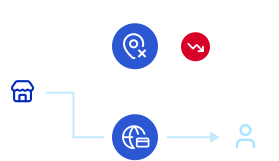 Your current status
The challenge of money remittances in emerging markets: Fragmented pay-in and pay-out networks
Each corridor requires different banks, wallets, and mobile money providers, leading to high integration and maintenance costs.
High integration and maintenance costs.
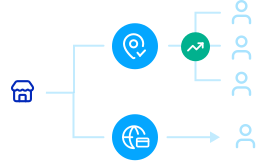 Remittance Solution
Solutions: Local payins and payout rails, connected through one integration
With Payins and Payouts, you integrate once and gain access to bank, eWallet, mobile money, real‑time payments, and card rails in 60+ markets, instead of building one corridor at a time.
Solved with a single integration.
-
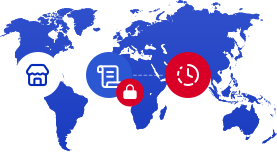 Your current status
The challenge of money remittances in emerging markets: Regulatory and compliance complexity
Remittances sit at the intersection of payments, FX, and AML/KYC regulations, which vary widely by country and can change quickly.
Regulatory complexity
 Remittance Solution
Solutions: Regulatory guidance and market expertise
dLocal brings deep expertise in local regulations and provides assistance navigating market rules, documentation, and best practices so your compliance and legal teams aren’t starting from scratch.
Manage the regulations of each new market
-
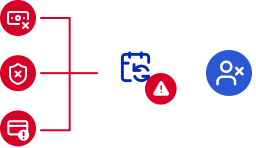 Your current status
The challenge of money remittances in emerging markets: User expectations of instant, always-on services
Customers now expect near real-time transfers, transparent status updates, and consistent experiences across channels and regions.
Frustrated customers
 Remittance Solution
Solutions: Simplified operations and automation
Through a single API and contract, you automate transfer initiation, routing, payouts, reconciliation, and reporting, reducing manual effort and errors across your operations.
Simple and automated process
Key solutions for money remittance
Explore solutions-
Payins
The core of your income
Learn more about PayinsBuild custom payin flows that fit your business and customer needs, allowing senders to fund transfers via cards, bank transfers, wallets, and other local methods.
-
Payouts
Pay using your preferred method and currency.
Learn more about PayoutsDeliver settlements in multiple currencies through local payout methods—bank transfers, mobile money, wallets, and card payouts—across 60+ markets.
-
Invoice Collection
For B2B or enterprise subscriptions
Learn more about Invoice CollectionWhere invoice-based B2B flows or platform-style arrangements are relevant, dLocal's broader solution set (Invoice Collection, dLocal for Platforms) can complement this stack to cover those scenarios as well.
Benefits for money remittance in emerging markets
-

Faster and more reliable cross-border transfers
Local rail lines and connections accelerate real-time delivery across key corridors, reducing delays, failures, and operational risks for every shipment.
-

Cost efficiency and better economics
A single API reduces technical costs, optimizes FX and unit economics, and automates operational reconciliation to offer competitive rates.
-

Simplified expansion and corridor strategy
Open or scale corridors without developing your own infrastructure, prioritizing payout methods and strategic countries by leveraging dLocal’s expertise.
-

Stronger compliance posture
Expert support for stablecoin licensing, AML, the Travel Rule, and KYT; centralized, traceable data that simplifies audits and banking requirements.
Key payment flows
-
Consumer cross-border remittance (sender to recipient)
This is the classic remittance model used by digital remittance providers, money transfer fintechs, and banks: an individual sender moves funds to a recipient in an emerging market, typically a family member or friend.
- 1
Sender funds the transfer.
Through Payins, dLocal collects funds in the sender's market via cards, bank transfers, eWallets, or other supported local methods you choose to expose.
- 2
dLocal clears, converts, and routes.
dLocal handles local authorization, FX conversion to the destination currency, and routes the payout via the right rail.
- 3
Recipient receives funds locally.
Through Payouts, the recipient gets funds via bank transfer, eWallet, mobile money, real-time payments, or card payout, depending on the corridor and your configuration.
- 4
Status returns to your platform.
Real-time confirmation flows back via webhooks for sender notifications and your reconciliation.
- 1
-
Wallet- and account-embedded remittance
For digital wallets, super apps, and neobanks adding cross-border transfers as part of a broader financial product, the sender doesn't initiate from a remittance app, they trigger a transfer from inside their existing wallet or account balance.
- 1
You hold the sender balance.
The user moves funds from their wallet or account; your system instructs dLocal via API.
- 2
dLocal executes the cross-border payout.
Through Payouts, dLocal delivers funds in the recipient's preferred local method, wallet top-up, mobile money, bank transfer, or real-time scheme.
- 3
Reconciliation aligns with your ledger.
Reporting and statements integrate with your internal balance system and compliance records.
- 1
-
Stablecoin-native and crypto-treasury remittance
For providers that already use USDC or USDT internally to move value across regions, hedge FX, or offer crypto-denominated balances, dLocal acts as the bridge between stablecoin treasury and local fiat delivery in emerging markets. You stay in charge of custody and on-chain logic; dLocal handles the fiat leg and, where applicable, on-chain payouts directly to recipient wallets.
- 1
You fund dLocal in stablecoins.
Through Stablecoin Full, you transfer USDC or USDT on a supported network to your dLocal balance, replacing USD wires.
- 2
Last-mile delivery your way.
dLocal converts stablecoins to local currency and pays out via banks, wallets, mobile money, or real-time rails (Off-Ramp), or sends Stablecoin Payouts directly to a recipient's wallet on a supported network where the corridor allows it.
- 3
Compliance on the on-chain leg.
KYT, wallet screening, and Travel Rule controls run through dLocal's licensed partners; specific availability depends on jurisdiction.
- 1
Payment methods relevant to the sector
Remittance success depends on supporting the payout and payin methods that senders and recipients already trust:
View all payment methods-
Bank transfers
Essential for customers who want funds deposited to current or savings accounts in their local banking systems.
-
eWallets
Central in digital ecosystems where wallet apps act as the main financial hub for users.
-
Mobile money
A cornerstone of remittances in many African markets, where mobile money is the primary digital rail.
-
Real-time payments
Growing in importance as more markets adopt instant payment schemes, making cross-border experiences feel closer to domestic transfers.
-
Cards
Useful both on the funding side (sender payins) and, in some markets, on the payout side via card-based disbursements.
-
Stablecoins (USDC/USDT)
Available as an additional layer via Stablecoin Full for funding payouts, paying recipients with a wallet, or converting to local currency through Off-Ramp, on the networks listed on dLocal's stablecoins page.
Got questions?
-
How does dLocal help keep remittance fees competitive?
By giving you access to local rails and partners through one integration, dLocal can help improve your underlying cost structure—on both payin and payout sides.
This allows you to offer fees and FX spreads that are attractive to senders and recipients, while still protecting your margins.
-
Can we keep using our existing correspondent and banking network?
Yes. dLocal can complement your existing network rather than replace it.
You can route specific corridors, payout methods, or regions through dLocal while maintaining other relationships where they make sense, then combine data and settlement internally.
-
How does dLocal support compliance and AML/KYC?
You retain overall responsibility for KYC/AML policies and customer onboarding, while dLocal provides local expertise, transaction data, and, where stablecoins are used, KYT, wallet screening, and Travel Rule controls through licensed partners. This combination helps you detect unusual patterns and support regulatory reporting and audits across jurisdictions.
-
Can we fund payouts in stablecoins or pay recipients directly in stablecoins?
Yes. Through Stablecoin Full, you can fund your dLocal balance with USDC or USDT instead of USD wires, and use Stablecoin Payouts to send funds directly to a recipient's wallet on a supported network where the corridor allows it. For recipients who want local currency, dLocal converts and disburses through local rails via Off-Ramp. Availability of stablecoins, networks, and corridors depends on jurisdiction and is confirmed during onboarding.
-
What payout options can recipients use?
Depending on the country, recipients can access funds via bank transfers, eWallets, mobile money, real‑time payments, and cards. Where applicable, stablecoin payouts to a recipient wallet are also possible.
The exact mix varies by market, and dLocal works with you to prioritize the options that best fit your corridors and user base.
-
How long does it take to add a new country or corridor?
Once integrated, adding a new market is primarily about configuration and compliance alignment, not a new build from scratch.
Most remittance providers can test and roll out new corridors faster than with a traditional, partner-by-partner approach, while keeping a consistent operational model.
Are you ready to convert more interested prospects into active, transacting customers?
If you’re ready to integrate instant and cost‑effective payment methods your customers trust, talk to dLocal about how our infrastructure can power your next phase of remittance growth in emerging markets.
Grow your business