With dLocal, eLearning providers can expand into 60+ emerging markets and accept payments through 1,000+ local and alternative methods, while we manage FX, regulatory complexity, and payouts to instructors and partners behind the scenes.
Use it when you:
-

Need to increase enrollments and completion rates
in markets where students rely on local wallets, bank transfers, and cash—and international cards are rare.
-

Want to support flexible revenue models
subscriptions, one‑off course purchases, installments, and B2B training—without stitching together multiple PSPs.
-

Must pay instructors, tutors, and partners
in their local currencies and methods, with predictable settlement and less manual work.
-

Operate cross‑border and need a partner
to navigate FX, tax, and regulatory requirements in 60+ countries.
-

Want a single view of learner payments
and payouts across regions, instead of fragmented systems.
The challenge of eLearning payments in emerging markets
-
 Your current state
The challenge of eLearning payments in emerging markets: Learners prefer local payment methods and currencies
In markets like Nigeria and India, students rely on local methods such as Paga or UPI, not international cards. When these options aren’t available, they simply can’t enroll or complete checkout.
Lost learner enrollments
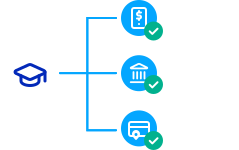 eLearning solution
Solutions: Localized payins aligned to learner preferences.
With Payins, you offer local cards, wallets, bank transfers, real‑time payments, cash, and mobile money so students can pay how they already pay for other digital services—using methods like Paga in Nigeria or UPI in India.
Drive student enrollments
-
 Your current state
The challenge of eLearning payments in emerging markets: Slow approvals, 3DS friction, and missing APMs drive drop-off
Without local acquiring and flexible 3DS, slow approvals, hard declines, and lack of installments or alternative methods lead to cart abandonment at the final step.
high checkout drop-off
 eLearning solution
Solutions: Smarter routing and approvals
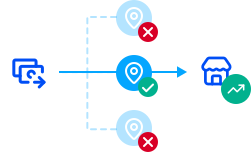
Smart Routing and Smart Requests send transactions through the best local routes, improving approval rates and reducing delays and cart abandonment.
Maximize approval rates to reduce cart abandonment
-
 Your current state
The challenge of eLearning payments in emerging markets: Peak periods expose weak points
At back-to-school, start of academic terms, or major promotional dates, payment systems must handle high volumes without delays or failures that block enrollments.
Severe lost sales spikes during peak enrollment periods
 eLearning solution
Solutions: Secure, low-friction experiences
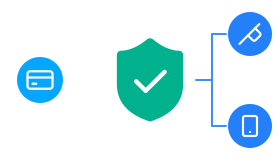
Network Tokenization, flexible 3DS, and fraud prevention tools help you reduce fraud while preserving a smooth, mobile-first checkout for students and institutions.
Secure checkouts with sustained high volumes during peak periods
-
 Your current state
The challenge of eLearning payments in emerging markets: No local presence makes new markets hard to enter, and paying instructors/partners locally is slow and manual
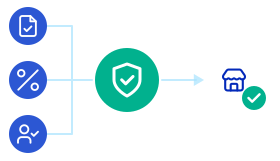
Building local entities, banking relationships, and regulatory setups in each country is complex and expensive. On top of that, paying instructors, tutors, and content partners in local currencies requires managing banks, FX, and documentation per market — stretching lean, digital-first teams.
Regulatory, financial, and operational resources under strain
 eLearning solution
Solutions: Less regulatory and FX burden, with local-currency payouts
dLocal's local entities, licenses, and Merchant of Record role (where applicable) help you navigate tax, FX, and KYC/AML requirements in each market without standing up that infrastructure yourself. With Payouts, you can also pay instructors, tutors, and content partners in their preferred methods and local currencies, avoiding manual bank files per country.
Regulatory, tax, FX, and operational barriers removed
Key solutions for eLearning
Explore all-
Payins
The core of your revenue
Learn more about PayinsAccept student payments via local cards, bank transfers, real-time payments, wallets, cash, and mobile money, with smart routing and intelligent retries to improve approval rates across 60+ countries.
-
Payouts
Pay in their preferred method and currency
Learn more about PayoutsPay instructors, tutors, and partners in their preferred methods and currencies, with batch and mass payouts and unified reconciliation.
-
Invoice Collection
For B2B or institutional collections
Learn more about Invoice CollectionStreamline B2B and institutional collections in local currencies, addressing local regulation and FX challenges while enabling easy funds transfer back to your home currency.
-
Defense Suite
Protect revenue from fraud
Learn more about Defense SuiteManage fraud and disputes across regions with real-time monitoring, ML models, and chargeback workflows tuned to digital and education flows.
-
dLocal for Platforms
Powering multi-provider education platforms
Learn more about dLocal for PlatformsSupport marketplace-style models for multi-provider platforms, with onboarding, balances, and split payments across learners and course providers.
Benefits for your eLearning business in emerging markets
-

Higher enrollment and completion rates
Local methods and smart routing boost approval rates, reducing checkout friction to drive enrollments and LTV.
-

Simpler operations and reconciliation
A single API across 60+ markets unifies payins, payouts, and reporting to eliminate manual reconciliation.
-

Reduced regulatory and FX complexity
Local entities and Merchant of Record models handle tax, FX, and KYC compliance without extra infrastructure.
-

Faster expansion into new markets
Reuse one integration to launch new markets and easily scale into B2B or marketplace models.
Key payment flows
-
Student payments and subscriptions
For most eLearning platforms, the core flow is enrollment, billing, and renewals:
- 1 Learner chooses a course, plan, or bundle

They select a single course, subscription, or bundle, usually priced in local currency and often with discounts tied to academic or promotional periods.
- 2 Learner selects a local payment method

At checkout, they see local cards, wallets, bank transfers, real‑time payments, cash options, or mobile money relevant to their country—removing the barrier of “card‑only” enrollment.
- 3 dLocal processes the payment locally

The transaction is processed via local acquirers and rails, using Smart Routing and Smart Requests to maximize authorization and minimize delays or declines.
- 4 Enrollment is confirmed

Once approved, your platform activates the course or subscription and records the payment status via webhooks and in the dLocal dashboard.
- 5 Renewals and retries

For recurring plans, you trigger renewal attempts on agreed schedules; dLocal’s local acquiring and tokenization where available help improve renewal success, reducing involuntary churn.
- 1
-
B2B or institutional invoices
For corporate training, university deals, or school networks:
- 1 Invoice issued in local currency

You generate an invoice in the customer’s local currency and send it via your standard channels.
- 2 Customer pays via local methods

Using Invoice Collection, your customers settle invoices through local methods (bank transfers, cards, or other local rails), with dLocal handling FX and regulatory frictions.
- 3 Funds moved to your settlement currency

dLocal converts and transfers funds to your chosen settlement currency and account, providing documentation aligned with local requirements.
- 1
-
Instructor and partner payouts
For marketplaces or platforms working with multiple educators:
- 1 Learner payments collected via Payins

Students pay via local methods; revenue is attributed to courses, instructors, or partner organizations.
- 2 Balances updated per instructor or partner

In a platform model, balances are tracked at instructor/partner level through dLocal for Platforms or your internal ledger.
- 3 Payouts triggered via Payouts

On a weekly or monthly schedule, Payouts disburses funds in local currencies and via preferred methods (bank accounts, wallets, etc.), with dLocal handling FX and local rails.
- 1
Industry-Relevant Payment methods
For eLearning in emerging markets, the right mix of payment methods per country directly affects enrollment and completion:
See all payment methods-
Cards
Still important, especially for recurring subscriptions and higher-ticket programs, and stronger when combined with 3-D Secure, tokenization, and local acquiring.
-
eWallets
Widely used for online transactions, especially on mobile and in younger demographics, giving students a familiar, low-friction payment path.
-
Bank transfers
Critical for students who prefer paying directly from their bank accounts or through domestic schemes, especially when international rails are limited.
-
Real-time payments
Instant bank schemes (like Pix-style or UPI-style flows) provide fast, low-friction enrollment and can reduce failure rates during onboarding peaks.
-
Cash and cash vouchers
Let students without bank access pay over the counter in local stores and agents, making digital education accessible to cash-based segments.
-
Mobile money
Essential across much of Africa, where it is a primary rail for everyday and education payments.
Got questions?
-
How does dLocal help reduce cart abandonment for eLearning?
dLocal aligns your checkout with local learner preferences by exposing local methods (such as Paga in Nigeria or UPI in India) and processing payments via local acquiring and Smart Routing.
This reduces declines and delays, and flexible 3DS plus Network Tokenization help keep flows secure without unnecessary friction, especially on mobile.
-
Can we use dLocal only for emerging markets alongside our global PSP?
Yes. Many education platforms use dLocal specifically for emerging markets while maintaining other providers for more mature regions.
You route traffic based on geography or segment, and combine dLocal’s settlements and reporting with other PSPs in your BI and treasury tools.
-
How does dLocal support payouts to instructors and partners?
With Payouts, you can pay instructors, tutors, and partners in their local currencies, using local methods such as bank transfer, wallets, and other region‑specific rails.
If you operate a marketplace model, dLocal for Platforms helps you manage balances and split payments between your platform and providers in a single flow.
-
How does dLocal handle regulatory and FX complexity for eLearning?
dLocal operates via local entities and licenses, acting as Merchant‑of‑Record where applicable to navigate tax, FX, and KYC/AML requirements in each market.
We manage FX conversion and offshoring in line with local regulations, while you focus on course design, pedagogy, and growth.
-
Can dLocal support both B2C learners and B2B education contracts?
Yes. dLocal supports B2C flows via Payins and B2B/institutional flows via Invoice Collection in local currencies, with Payins and Payouts handling the rest of your revenue cycle.
This lets you unify student payments, corporate training contracts, and partner relationships on a single payments backbone.
-
How quickly can we go live with dLocal for eLearning?
Timelines depend on scope, but the single API and dashboard‑driven configuration are designed for fast onboarding.
Many platforms start with priority markets and a subset of methods, then expand coverage and add advanced flows (payouts, marketplaces, invoice‑based B2B) as adoption grows.
Ready to grow your eLearning business in emerging markets?
If you're ready to make sure payments never stop a learner from starting their journey with you, no matter where they are, talk to dLocal about how our solutions can support your eLearning expansion in emerging markets.
Grow your business