With dLocal, retailers get a local‑to‑local payment infrastructure that powers ecommerce and omnichannel experiences across 60+ emerging markets, so you can turn more carts into customers while we handle local rails, FX, and risk behind the scenes.
Use it when you:
-

Need to cut cart abandonment by offering local favorites like Pix in Brazil
OXXO in Mexico, wallets, instant bank transfers, cash vouchers, and mobile money instead of cards only.
-

Want to support installments and BNPL at scale
so shoppers can comfortably complete high‑ticket purchases without you managing each scheme directly.
-

Run cross‑border or regional ecommerce
and need local‑to‑local acquiring to keep approval rates high and FX predictable.
-

Need reliable refunds and returns
including partial refunds—that don’t automatically escalate into chargebacks and heavy manual work.
-

Operate omnichannel retail (online + in‑store)
and want a shared payment backbone and reporting layer across channels.
The challenge for retailers in emerging markets
-
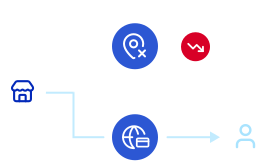 Your current status
The challenge for retailers in emerging markets: Missing local methods and BNPL
When familiar methods or installment options are absent, shoppers abandon purchases. Unclear FX and pricing add friction, especially for cross-border carts.
Interrupt checkout
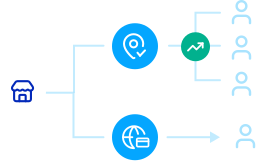 Retailer Solution
Solutions: Localized Payins and installments
Offer relevant cards, wallets, bank transfers, real-time payments, cash options, BNPL and installments in local currency. Local acquiring and Smart Routing support approvals.
Meet shoppers at checkout
-
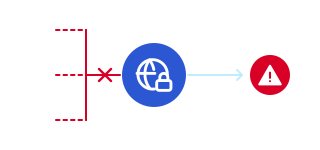 Your current status
The challenge for retailers in emerging markets: Refunds and fragmented integrations
Slow or fragmented returns can become chargebacks. Every additional local PSP, contract and reconciliation process makes expansion harder to manage.
Slow operations
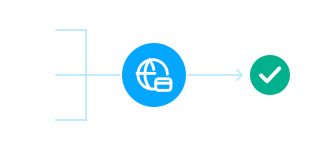 Retailer Solution
Solutions: Payouts, invoicing and one API
Pay suppliers and partners in local currency, collect B2B and wholesale invoices, and view payins, payouts and reconciliation through one integration and dashboard.
Simplify retail operations
-
 Your current status
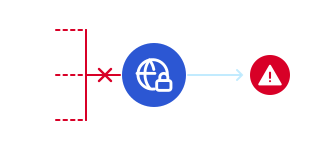
The challenge for retailers in emerging markets: Limited local routing and fraud controls
Generic rules and missing local routing can cause avoidable declines on domestic cards and alternative payment methods, while making fraud harder to manage across markets.
Block good orders
 Retailer Solution
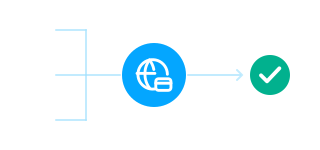
Solutions: Defense Suite and unified reporting
Use retail-tuned fraud monitoring and dispute workflows while tracking transactions and settlement in a consistent view across markets.
Protect every order
Key solutions for retailers
Explore solutions-
Payins
Accept retail payments locally
Learn more about PayinsCollect online and omnichannel payments in shoppers’ local currencies using 1,000+ methods, with local‑to‑local acquiring and Smart Routing to improve approval rates and reduce cart abandonment. Includes the option to accept stablecoins (USDC/USDT) at checkout via Stablecoin Full where relevant.
-
Payouts
Pay suppliers and logistics partners
Learn more about PayoutsPay suppliers, logistics partners, and other stakeholders in their preferred local methods and currencies, while dLocal manages FX, local rails, and unified reconciliation.
-
dLocal for Platforms
Manage multi-brand balances and splits
Learn more about dLocal for PlatformsSupport multi‑brand or seller‑like models with onboarding, balances, and split payments, without rebuilding your payments architecture.
-
Defense Suite
Control fraud and disputes
Learn more about Defense SuiteIdentify and mitigate fraudulent transactions in real time, manage disputes, and reduce chargebacks while protecting legitimate shoppers.
-
Invoice Collection
Collect B2B and wholesale invoices
Learn more about Invoice CollectionIssue and collect local‑currency invoices for B2B, wholesale, or supply‑chain flows, while dLocal handles collection, FX, and settlement.
Benefits for retailers in emerging markets
-

Higher conversion and larger baskets in emerging markets
Local methods and currencies reduce checkout friction and abandonment for both first‑time and returning shoppers. Local acquiring and Smart Routing improve approval rates compared to cross‑border‑only setups, especially on local cards and APMs. Installments and BNPL unlock demand for high‑AOV purchases and encourage larger baskets without additional operational complexity.
-

Simpler operations and reconciliation
One partner, one integration, one dashboard for payins, payouts, refunds, and B2B flows across 60+ markets. Fewer local PSPs and banks to manage, and less manual consolidation of fragmented reports for finance and operations.
-

Reduced fraud, chargebacks, and compliance burden
Defense Suite plus local rails help reduce fraud and chargebacks by aligning controls with local patterns and regulations. Centralized dispute workflows give better visibility into net revenue after fraud and chargebacks, while dLocal’s local entities and regulatory expertise help you meet local payment, FX, and documentation rules without building in‑house teams in every country.
-

Faster expansion and experimentation
Launch new countries with reusable integration patterns, not bespoke PSP setups for each market. Experiment with new payment methods, installments/BNPL, and merchandising models while keeping your payments backbone consistent.
Key payment flows
-
Customer purchases (ecommerce and omnichannel)
This is the core flow: browse - add to cart - checkout - pay - fulfill.
- 1
Shopper builds their cart and selects currency
They see prices in their local currency, with taxes and fees handled according to local rules where applicable.
- 2
Shopper chooses a local payment method
At checkout, they pick from domestic and international cards, BNPL, wallets, bank transfers, real‑time payments (like Pix), mobile money, or cash vouchers—depending on the market.
- 3
dLocal processes the payment locally
dLocal routes the transaction through local acquirers and rails, using Smart Routing to maximize approval rates and reduce declines.
- 4
Order is confirmed and captured
You confirm the order and, where supported, can use multiple captures and other retail‑friendly flows (for example, split capture for partial shipments).
- 5
Refunds and returns
For cancellations, returns, or exchanges, you trigger full or partial refunds through dLocal. Status and disputes are tracked centrally so you can understand net revenue and margin per market and product line.
- 1
-
Marketplace‑style or multi‑partner flows (where relevant)
Some retailers operate multi‑brand or seller‑like models even if they’re not full marketplaces.
- 1
Buyer pays the primary retailer at checkout
A single payment may cover products from multiple internal brands or partner sellers, plus shipping and platform fees.
- 2
Funds are allocated internally and to partners
Your systems define split rules (commissions, fees, taxes) and attribute funds per brand, cost center, or partner.
- 3
Local‑currency payouts are executed
Payouts sends funds to partners or regional entities via local methods, while your margin and taxes remain visible in consolidated reporting.
- 1
-
Installments, BNPL, and high‑AOV purchases
In markets where installments and BNPL drive conversion:
- 1
Choose a higher-value item
Shopper selects a higher‑ticket item (electronics, furniture, fashion, luxury).
- 2
Select installments or BNPL
At checkout, they choose installments or BNPL from options integrated via dLocal’s Payins layer.
- 3
Process the installment payment
dLocal coordinates the underlying schemes and providers, so you receive funds per your commercial model while the shopper pays over time.
- 4
Track BNPL performance
You track performance of installments and BNPL in the same reporting layer as other methods, seeing impact on conversion and AOV.
- 1
-
B2B Flow
Para los flujos B2B, mayoristas y de la cadena de suministro:
- 1
You issue a local‑currency invoice
Through Invoice Collection, you generate invoices for B2B buyers, resellers, or supply partners in their local currency.
- 2
Customer or partner pays via local methods
They pay using cards, bank transfers, real‑time schemes, or other local methods supported in that market.
- 3
dLocal handles collection and FX
dLocal collects funds, performs FX conversion, and settles to your main currency (e.g., USD or EUR) based on agreed models.
- 4
Reconciliation aligns B2B and B2C revenue
B2B flows appear alongside consumer transactions and payouts, giving you a complete revenue view by market and partner.
- 1
Key payment methods for retailers
To succeed in emerging markets, retailers need the right mix of payment methods per country, not a single global setup:
View all payment methods-
Cards (local and international)
Still a backbone for online retail, especially when paired with 3DS, tokenization, and intelligent retries to improve approval rates.
-
BNPL and installments
Critical in high‑AOV segments (electronics, fashion, furniture); they let shoppers pay over time while you receive funds per your commercial model.
-
Digital wallets
Ubiquitous in many Asian and Latin American markets, often the default for mobile‑first shoppers.
-
Bank transfer and real‑time payments
Schemes like Pix and other instant rails provide low‑friction payments with strong adoption and lower failure rates.
-
Cash and cash vouchers
Essential for reaching cash‑preferring or underbanked shoppers by bridging offline and online.
-
Mobile money
Critical across many African markets, where mobile money accounts are often the primary digital store of value.
Got questions?
-
How does dLocal help reduce cart abandonment in emerging markets?
dLocal reduces cart abandonment by matching local payment preferences and currencies at checkout. Shoppers see methods they already use—cards, wallets, instant bank transfers, cash vouchers, mobile money, BNPL, and installments—and pay in familiar local currency. Local acquiring and Smart Routing further improve approval rates, so fewer valid orders fail at the payment step.
-
Can we use dLocal only for specific regions while keeping our current PSP elsewhere?
Yes. Many retailers and marketplaces use dLocal specifically for emerging markets while keeping other PSPs for mature regions. You can route transactions to dLocal based on country, brand, or channel, then consolidate reporting and settlement internally across providers.
-
How does dLocal support refunds, partial returns, and exchanges?
Refunds and partial refunds for supported methods are initiated through dLocal and reflected in your reporting and dashboards. Combined with centralized dispute data, this makes it easier to track the full lifecycle of an order—including returns and chargebacks—and understand net revenue per market and product line.
-
How does dLocal handle installments and BNPL for retail?
dLocal connects you to local installment and BNPL schemes through Payins, so you can expose flexible payment options at checkout without integrating each provider directly. You receive funds according to your commercial model, while shoppers pay over time; performance is tracked alongside other methods in one reporting layer.
-
What does integration look like for an existing ecommerce platform?
You integrate once with dLocal’s API or hosted checkout, mapping your existing payment flows to our methods and countries. From there, you can add markets and payment methods iteratively without re‑architecting your core commerce platform, while keeping configuration, monitoring, and settlements centralized.
-
How long does it typically take to go live?
Timelines depend on scope and internal resources, but the single API and standardized flows are designed for fast onboarding. Many retailers start with priority markets and methods, then expand coverage, add installments/BNPL, and roll out payouts or invoice‑based flows over time.
Ready to make every cart local?
If you’re ready to accelerate your retail growth with smarter payments in Africa & Middle East, Asia, and Latin America, talk to dLocal about how our solutions can power your expansion in emerging markets.
Grow your business