In Africa & Middle East, Asia, and Latin America, those expectations collide with high volumes of small orders, local payment habits, and complex regulations. dLocal provides the payment infrastructure layer that keeps all three sides moving—connecting your platform to 60+ emerging markets and 1,000+ local payment methods through a single API.
Use it when you:
-

Need to support peak-hour spikes
without payment failures or queuing delays.
-

Want to offer APMs and wallets
like Pix, Yape, mobile money, SPEI, PayNow, and others, not just cards.
-

Must provide instant or near real-time payouts
to couriers and fast, predictable settlements to restaurants.
-

Operate across multiple emerging markets
and want one integration and contract for all payins and payouts.
-

Need to reduce fraud and chargebacks
without adding friction to checkout.
The challenge of food delivery in emerging markets
-
 Your current status
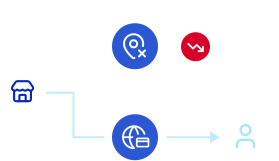
The challenge of food delivery in emerging markets: Local payment method fragmentation
Customers expect Boleto and Pix in Brazil, SPEI in Mexico, Yape in Peru, mobile money in Kenya, wallets and bank transfers across Asia—credit cards are not the norm.
The lack of local payment methods hinders growth.
 Food Delivery Solution
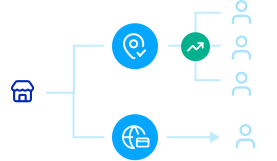
Solutions: Local, mobile-first payins that match how people really pay
With Payins, you offer customers local cards, BNPL, wallets, bank transfers, mobile money, cash vouchers, and real-time payments (e.g., Pix, Yape, SPEI, PayNow), all in local currency. Smart Routing keeps transactions on local rails, improving approval rates and reducing declines at peak times.
Higher approval rates, fewer minor rejections
-
 Your current status
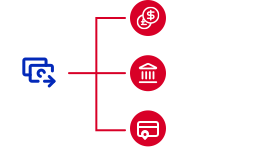
The challenge of food delivery in emerging markets: Real-time payouts to restaurants and couriers
Restaurants and couriers expect fast access to funds to manage working capital and fuel loyalty; delays can lead to churn and operational disruptions.
Loss of confidence and profit margins.
 Food Delivery Solution
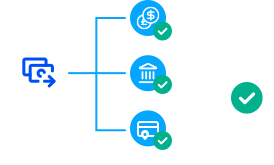
Solutions: Fast payouts for couriers and restaurants
With Payouts, you can pay couriers, riders, and restaurants in local currencies via bank transfers, wallets, mobile money, or card payouts. Payouts can be instant, daily, or scheduled, giving partners predictable access to funds and reducing churn.
Stable renewals, reach beyond cards
-
 Your current status
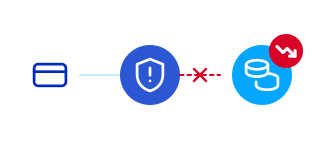
The challenge of food delivery in emerging markets: High fraud risk with low tolerance for friction
Stolen cards, promo abuse, account takeovers, and friendly fraud must be controlled without adding steps to already quick purchase flows.
Debt write-offs, disputes, and increased operating expenses
 Food Delivery Solution
Solutions: Fraud prevention tailored to high-frequency, low-ticket flows
With Defense Suite, you get tools to detect and manage fraud—card testing, incentive abuse, account takeover—without over-blocking legitimate orders. This keeps approval and order completion rates high while protecting margins.
Frictionless fraud protection
Key solutions for food delivery
Explore solutions-
Payins
The core of your income
Learn more about PayinsAccept local payment methods (cards, BNPL, wallets, bank transfers, mobile money, cash-based options, and real-time schemes) with local acquiring and Smart Routing.
-
Payouts
Pay using your preferred method and currency.
Learn more about PayoutsPay couriers, riders, and restaurants in their preferred local methods and currencies, supporting instant or scheduled payout cycles.
-
dLocal for Platforms
Designed for platforms with multiple participants
Learn more about dLocal for PlatformsPower multi-sided marketplace flows, with sub-accounts, balances, and splits between your platform, restaurants, and partners.
-
Defense Suite
Manage fraud without friction.
Learn more about Defense SuiteManage fraud and disputes effectively in high-frequency, low-ticket environments.
-
SmartAPMs
Tokenized experiences driving conversion
Turn leading APMs into tokenized, card-on-file-like experiences, boosting conversion and repeat orders across key markets.
Benefits for Food Delivery in emerging markets
-

Higher conversion and fewer drop-offs
Local payment methods, tokenized APMs, and Smart Routing reduce abandonment, increase authorization rates, and drive repeat purchases among both banked and unbanked users.
-

Happier couriers and restaurants through faster payouts
Fast payouts retain delivery drivers and provide predictable settlements to restaurants, boosting satisfaction and loyalty on your platform.
-

Simpler operations and scalable payment backbone
A single integration and dashboard for multiple markets reduces the number of local providers, streamlines reconciliation, and standardizes your global expansion.
-

Stronger fraud, risk, and compliance management
Defense Suite mitigates fraud and promo abuse without friction, while local legal expertise ensures compliance and centralized risk reporting.
Key payment flows
-
Customer ordering and payment
The core flow that repeats thousands (or millions) of times per day:
- 1
Customer builds their cart and sees pricing
They select restaurant, items, fees, and delivery charges, and see a final price in local currency, including taxes and service fees.
- 2
Customer chooses a local payment method
At checkout, they select from local cards, wallets, bank transfers, instant schemes like Pix or SPEI, mobile money, cash-on-delivery alternatives, or BNPL where supported.
- 3
dLocal processes the payment via local rails
dLocal routes the transaction through local acquirers and APM networks, applying Smart Routing to increase approval rates and reduce soft declines—even at peak hours.
- 4
Order is confirmed in real time
Once authorized, your platform confirms the order to the restaurant and starts fulfillment, while dLocal manages tokenization or APM-on-file where supported.
- 5
Adjustments, cancellations, and refunds
If an order is canceled, partially fulfilled, or changed, you trigger partial or full refunds or credits through dLocal. Refunds appear in the same reporting layer as original orders.
- 1
-
Courier earnings and payouts
Courier satisfaction relies on fast, predictable access to earnings:
- 1
Earnings accumulate per courier
Each completed order (plus tips, incentives, and bonuses) adds to a courier’s earnings balance.
- 2
Platform defines payout rules and methods
You configure payout cycles and thresholds (e.g., on-demand, daily, weekly) and payout methods (bank, wallet, mobile money, card payouts).
- 3
dLocal executes payouts via local rails
Using Payouts, dLocal disburses funds in local currency according to your rules, leveraging mobile money, eWallets, or bank transfers where they matter most.
- 4
Couriers receive funds and notifications
Couriers see updated balances in your app and can access funds quickly and reliably, building trust and retention.
- 5
Payout reporting and reconciliation
dLocal provides payout reports by courier, method, and date, simplifying reconciliation and enabling better unit economics analysis per market.
- 1
-
Restaurant settlements and marketplace flows
For restaurant-first or marketplace models:
- 1
Customer pays the platform
The payment covers menu items, platform fees, and delivery charges, and flows into your platform-level account.
- 2
Balances are tracked per restaurant and partner
Your logic allocates each order’s revenue to restaurants, your platform, and other partners after fees, commissions, and promotions.
- 3
dLocal for Platforms manages balances and splits
With dLocal for Platforms, you can manage sub-accounts or balances per restaurant, enabling clear, auditable funds tracking.
- 4
Restaurant payouts are executed via Payouts
Funds are disbursed to restaurants in local currencies via bank transfers or other preferred methods, according to agreed payout schedules.
- 5
Unified reconciliation across restaurants and markets
You can review restaurant settlements, commissions, and fees across all markets in one place, reducing operational workload.
- 1
Payment methods relevant to the sector
Food delivery success in emerging markets depends on supporting the payment methods your users already trust:
View all payment methods-
Cards (local and international)
Important for many users but often not the primary method; best when combined with tokenization and smart retries for repeat orders.
-
eWallets and mobile wallets
Central in many markets (e.g., Yape in Peru, mobile wallets across Asia), especially for mobile-first and unbanked consu
-
Mobile money
Crucial in African markets for both customer payments and courier payouts.
-
Real-time bank payments and instant schemes
Such as Pix in Brazil, SPEI in Mexico, and other instant rails, ideal for fast, low-friction settlements.
-
Cash and cash-like options
Still necessary in markets where cash remains strong, often combined with voucher or invoice flows.
-
BNPL and installments
More relevant for high-basket grocery or multi-order scenarios, enabling flexibility in selected use cases.
Got questions?
-
Can we use dLocal only for courier payouts or only for customer payins?
Yes. Many platforms start with a specific pain point—such as courier payouts or APMs for customers—and then expand over time.
You can adopt dLocal’s capabilities modularly, while keeping a path toward a unified payment backbone.
-
How does dLocal help during peak hours when volumes spike?
dLocal’s infrastructure and Smart Routing are built for high-volume, low-ticket environments.
By keeping transactions on local rails and using APMs-on-file, we help maintain high approval rates and low latency, even during lunch and dinner peaks.
-
How do refunds and partial refunds work for canceled or incorrect orders?
Refunds—full or partial—are triggered through dLocal and processed back to the same or equivalent method where supported.
Refunds and chargebacks appear in your reporting and reconciliation alongside original orders, providing a clear view of net revenue.
-
How quickly can we add new payment methods or markets?
Once integrated, adding new markets and methods is primarily a configuration and testing exercise, not a full new build.
You can gradually expand your footprint and method mix while keeping the same integration pattern and operational model.
-
Does dLocal support wallet or balance-based models inside our app?
Yes. dLocal can act as the underlying payin and payout layer for your internal wallets or balances, funding and settling them via local rails, while you own the in-app experience and ledger.
Are you ready to turn more interested prospects into customers who place and complete their orders?
If you’re ready to grow your platform with payments built for every order, talk to dLocal about how our infrastructure can power your food delivery expansion in emerging markets.
Grow your business