
In Africa & Middle East, Asia, and Latin America, that means navigating dozens of local rails, regulations, and behaviors that don’t look like traditional card-only markets. dLocal gives retailers a local-to-local payment infrastructure that powers e‑commerce, point-of-sale, and omnichannel experiences—so you can grow faster without rebuilding your payments stack country by country.
Use it when you:
-

Reduce cart abandonment
Need to reduce cart abandonment by offering shoppers their preferred local methods (cards, wallets, real-time payments, mobile money, cash, BNPL/installments).
-

Offer installments and BNPL
Want to support installments and BNPL at scale, especially in markets where around 60% of retail transactions rely on installments.
-

Orchestrate marketplace payments
Run a marketplace or multi-seller platform and must orchestrate payins, commissions, and payouts to sellers and partners.
-

Manage refunds and returns
Need reliable refunds, partial returns, and exchanges that don’t automatically turn into chargebacks or operational overhead.
-

Expand with one payment partner
Are expanding across 60+ emerging markets and want one partner for local-to-local acquiring, routing, fraud prevention, and reporting.
The challenge facing the Retail sector in emerging markets
-
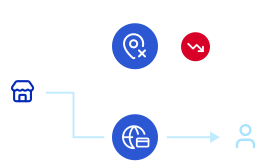 Your current status
The challenge facing the Retail sector in emerging markets: Local payment gaps interrupt checkout
Shoppers leave when they cannot pay in local currency with the methods they use every day. Complex installment setup and unclear FX add friction to higher-value and cross-border purchases.
Missing familiar methods, installments or clear prices can cost a sale.
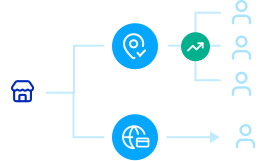 Retail Solution
Solutions: Local Payins and flexible payments fit the shopper
Payins brings local cards, wallets, bank transfers, real-time payments, cash options and mobile money into one checkout. Local acquiring and Smart Routing support authorization, while installments and BNPL add flexibility where available.
Offer local methods, BNPL and installments in the shopper’s currency.
-
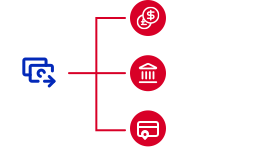 Your current status
The challenge facing the Retail sector in emerging markets: Añadir métodos país por país implica más PSP, contratos y procesos de conciliación. Sin routing por país, las tarjetas locales y los métodos alternativos pueden sufrir rechazos innecesarios.
Adding methods country by country means more PSPs, contracts and reconciliation processes. Without country-level routing, local cards and alternative methods can suffer unnecessary declines.
Every local provider adds work; weak routing adds avoidable declines.
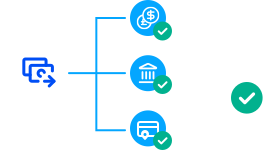 Retail Solution
Solutions: Payouts, invoices and one API connect retail flows
Pay sellers and suppliers in local currency with Payouts, and collect B2B or wholesale invoices with Invoice Collection. One API and dashboard bring transactions, FX, settlement and reporting together across markets.
Manage seller payments, B2B collection and reconciliation together.
-
 Your current status
The challenge facing the Retail sector in emerging markets: Returns, fraud and compliance put revenue at risk
Slow refunds, partial returns and exchanges can escalate into chargebacks. Fraud patterns, documentation rules and regulation also vary across markets, stretching risk and finance teams.
Fragmented refunds and market-specific risk rules raise operational cost.
 Retail Solution
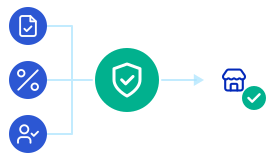
Solutions: Defense Suite and shared reporting protect revenue
Defense Suite helps identify fraudulent transactions, reduce false positives and manage chargebacks. Unified reporting makes orders, refunds, payouts and settlement easier to monitor across markets.
See fraud, disputes and settlement across markets in one view.
Key solutions for retail
Explore solutions-
Payins
Accept the methods shoppers prefer
Learn more about PayinsCollect online and omnichannel payments in shoppers’ local currencies using 1,000+ methods, with local-to-local acquiring and Smart Routing to improve approval rates and reduce cart abandonment.
-
Payouts
Pay sellers and partners locally
Learn more about PayoutsPay sellers, suppliers, and logistics partners in their preferred local methods and currencies, with dLocal managing FX, local rails, and consolidated reconciliation.
-
Invoice Collection
Collect B2B and wholesale invoices
Learn more about Invoice CollectionIssue and collect local‑currency invoices for B2B, wholesale, or supply-chain flows, while dLocal handles collection, FX, and settlement.
-
Defense Suite
Manage fraud and disputes
Learn more about Defense SuiteIdentify and mitigate fraudulent transactions in real time, manage disputes, and reduce chargebacks while protecting legitimate shoppers.
Benefits for Retail in emerging markets
-

Higher conversion and larger baskets in emerging markets
Local methods and currencies reduce checkout friction and abandonment. Local acquiring and Smart Routing increase approval rates vs. cross‑border-only setups.
-

Simpler operations and reconciliation
One partner, one integration, one dashboard for all key flows across 60+ markets. Fewer local PSPs and bank integrations to manage, and less time spent consolidating fragmented reports.
-

Reduced fraud, chargebacks, and compliance burden
Defense Suite and local rails help reduce fraud and chargebacks by aligning controls with local patterns and regulations. Centralized dispute workflows give you better visibility and control over net revenue after fraud and chargebacks. dLocal’s local entities and regulatory expertise help you comply with local payment, FX, and documentation rules without building in‑house capabilities in each country.
-
Faster expansion and experimentation
Launch new countries with reusable integration patterns, not bespoke PSP setups. Experiment with new payment methods, installments/BNPL, and marketplace models while keeping your payments backbone consistent. Add new verticals, brands, or seller segments to your platform without re‑architecting around local payments each time.
Key payment flows
-
Customer purchases (e‑commerce and omnichannel)
El flujo principal es: explorar - añadir al carrito - checkout - pagar - gestionar el pedido.
- 1
Shopper builds their cart and selects currency
They see prices in their local currency, with taxes and fees handled according to local rules where applicable.
- 2
Shopper chooses a local payment method
At checkout, they pick from domestic and international cards, BNPL, digital wallets, bank transfers, real‑time payments (like Pix), mobile money, or cash vouchers, depending on the market.
- 3
dLocal processes the payment locally
dLocal routes the transaction via local acquiring and rails, applying Smart Routing to maximize approval rates and reduce declines.
- 4
Order is confirmed and captured
You confirm the order and, where supported, can use multiple captures and other retail‑friendly flows (e.g., split capture for partial shipments).
- 5
Refunds and returns
For cancellations, returns, or exchanges, you trigger full or partial refunds through dLocal. Status and disputes are tracked centrally so you understand net revenue and margin per market.
- 1
-
Marketplace payins and seller payouts
For marketplaces and multi-seller platforms, payments are multi‑sided:
- 1
Buyer pays the platform at checkout
A single payment covers products from one or multiple sellers, plus shipping and any platform fees.
- 2
Funds are allocated to sellers and the platform
Your platform defines split rules (commissions, fees, taxes) and attributes funds to each seller or partner.
- 3
Balances and sub‑accounts are tracked
Using dLocal’s account and balance capabilities, funds are organized per seller, country, and currency under your main account.
- 4
Local-currency payouts are executed
Payouts send funds to sellers via bank transfers, card payouts, wallets, or mobile money, according to configured frequencies and thresholds.
- 5
Fees and taxes are retained
Your commission, marketplace fees, and any applicable withholdings are reflected in consolidated reporting, simplifying reconciliation and compliance.
- 1
-
B2B invoices and wholesale or supplier payments
For B2B, wholesale, and supply-chain flows:
- 1
You issue a local‑currency invoice
Through Invoice Collection, you generate an invoice for a B2B buyer, reseller, or supply partner in their local currency.
- 2
Customer or partner pays via local methods
They pay using cards, bank transfers, real‑time schemes, or other local methods supported in that market.
- 3
dLocal handles collection and FX
dLocal collects funds, performs FX conversion, and settles to your main currency (e.g., USD, EUR) based on agreed models.
- 4
Reconciliation aligns B2B and B2C revenue
B2B flows appear alongside consumer transactions and payouts, giving you a complete revenue view by market and partner.
- 1
Payment methods relevant to the sector
To succeed in emerging markets, retailers need the right mix of methods per country rather than a single global setup:
View all payment methods-
Cards
Still a backbone for online retail, especially when paired with 3DS, tokenization, and intelligent retries to improve approval rates.
-
BNPL and installments
Critical in high‑AOV and electronics/fashion segments; they enable shoppers to spread payments over time while merchants receive funds according to their commercial model.
-
Digital wallets
Ubiquitous in many Asian and Latin American markets, often the first choice for mobile-first shoppers.
-
Bank transfer and real-time payments
Schemes like Pix and other instant rails deliver fast, low‑friction payments with strong adoption and lower failure rates.
-
Cash and vouchers
Important for reaching cash‑preferring or underbanked shoppers, bridging offline and online.
-
Mobile money
Essential across many African markets, where mobile money accounts are the primary digital store of value.
Got questions?
-
How does dLocal help reduce cart abandonment in emerging markets?
By offering the local payment methods and currencies shoppers expect, dLocal reduces friction at checkout. Local acquiring and Smart Routing improve authorization rates, while support for wallets, real‑time payments, BNPL, and installments helps convert more shoppers who would otherwise drop off.
-
Can we use dLocal only for specific regions while keeping our current PSP elsewhere?
Yes. Many retailers and marketplaces use dLocal specifically for emerging markets while maintaining other PSPs for mature regions. You can route transactions to dLocal based on country, brand, or channel, then consolidate reporting and settlement internally across providers.
-
How does dLocal support refunds, partial returns, and exchanges?
Refunds and partial refunds for supported payment methods are initiated via dLocal and reflected in your reporting. Combining this with centralized dispute data makes it easier to track the full lifecycle of an order—including returns and chargebacks—and understand net revenue per market and product line.
-
What does integration look like for an existing e‑commerce platform?
You integrate once with dLocal’s API or hosted checkout, mapping your existing payment flows to our methods and countries. From there, you can add markets and payment methods iteratively without major re-architecture, keeping your core commerce logic intact while expanding coverage on the payments side.
-
¿Necesitamos entidades locales o cuentas bancarias en cada mercado de destino?
No. dLocal opera mediante entidades y licencias locales y puede actuar como Merchant of Record cuando corresponda. Esto significa que no necesitas abrir entidades locales ni cuentas bancarias en cada país para aceptar o enviar pagos.
Esto reduce la carga normativa y acelera tu expansión a nuevos mercados de origen y destino.
-
How long does it typically take to go live?
Timelines depend on your scope, integration model, and internal resources, but the single API and standardized flows are designed for fast onboarding. Retailers often start with priority markets and methods, then expand coverage, add installments/BNPL, and roll out payouts or invoice-based flows over time.
Are you ready to turn more interested people into customers?
Turn more shoppers into paying customers by matching local payment preferences in 60+ emerging markets.
Grow your business